Dublin City Council aims to support community groups with their activities and projects by promoting the participation and involvement in the city through the community grants scheme.
The Community Grants Scheme is run on an annual basis and is open for application from mid December of each year. The closing date is the last working day of January of the following year. The Grant Application forms will be available on line, from the local Area Offices and from Community and Social Development which is located in the Civic Offices. An Irish version of the application will also be available.
Community Groups make their applications while taking into consideration the key priorities of the scheme such as:
Forms are also available in hard copy in the South East Area Office in Block 2, Floor 4 of the Civic Offices and in the SEA Community Section in Block 2, Floor 3.
Fiona O’Brien, Staff Officer, Dublin City Council, South East Area Office, Block 2, Floor 4, Civic Offices, Wood Quay, Dublin 8.
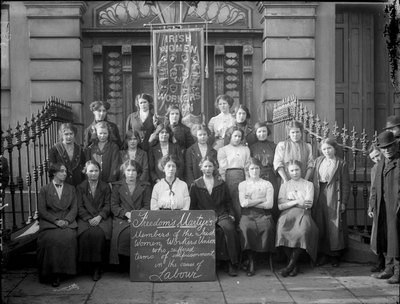
On this day in 1913 a young 16yr old woman, Alice Brady, was shot on the afternoon of December 18, 1913, during a protest on Mark Street during the Dublin Lockout, and died shortly afterwards. A convoy of eight coal carts had arrived on Mark Street during the strike and locals protested causing a disturbance which resulted in two shots being fired by one of the strike-breakers named Patrick Traynor, described as a free labourer, with an address in West Essex Street, near Wood Quay.
Alice was hit in the left hand and was brought by a young local girl into her house on 6 Mark Street where a dressing was placed on her wound. From there she was brought to St Patrick Dun’s Hospital and later released, but died a fortnight later on Thursday, January 1st, from lockjaw or tetanus, a not unusual outcome of gunshot wounds at the time, which made the discharging of any firearm a lethal matter.
Traynor’s trial split the city along social class lines and there was outrage when he was eventually found not guilty on a lesser charge by a jury of property owners.
Though aged only 16, Alice Brady was already working in a factory and was a member of the Women Workers’ Union. She lived with her parents in 21a Luke Street, off Townsend Street, and just around the corner from where she was shot in Mark Street.
At her funeral on January 5th, 1914, thousands gathered in Pearse St (then Great Brunswick St) to march in a “sombre funeral procession” to Glasnevin Cemetery. It was reported that 500 members of the Irishwomen Worker’s Union, to which Alice belonged, were in the cortege, which was headed by two bands.
Among those present were James Larkin, Delia Larkin, James Connolly and Countess Markievicz. In his graveside oration, James Larkin praised the courage of Alice Brady and said nothing could surpass the loyalty of the women workers. James Connolly said Alice was “as true a martyr for freedom as any who ever died in Ireland”. As it stands, she is remembered in Dublin only in a plaque in Liberty Hall and on her gravestone in Glasnevin, which reads: “Erected by Federated workers union of Ireland and Irish Transport and General Workers Union in memory of Alice Brady, factory worker age 16, who died January 1st 1914 as a result of civil strife associated with the 1913 lockout.” (Research, John Moran)
I will be presenting a motion to City Council for the erection of a significant plaque in the city to commemorate this young womans short life, and ultimate sacrifice.
Please find attached a press release for Voice of the Traveller magazine outlining our plans to launch into general newsagents on Thursday June 20th .
I have also attached a map of the geographical areas our regional reporters cover. If you would like to get in contact with one of our regional reporters please contact us through 09064 98017.
Voice of the Traveller Magazine Launches into 1200 Newsagents Nationwide.
Since its first edition in 1991, Voice of the Traveller has become the only magazine in Ireland specifically dedicated to profiling Traveller life today. It plays a key role in profiling Traveller culture, life and heritage, while remaining focused on current affairs and topical issues pertinent to the community.
A number of different media experts and designers have helped shape the magazine over recent years. As well as our regional reporters undergoing systematic training we now feel that Voice of the Traveller is at a standard to be displayed proudly on newsagent stands.
Written by Travellers for Travellers and the wider community, Voice of the Traveller serves as a window and guarantees its readers an authentic view of a community whose coverage in mainstream tabloids tends to be unrepresented and generally negative. Our regional reporters challenge the stereotypes and negative issues that have constantly arisen and only served to limit the potential growth of our community.
In recent editions of the magazine we have featured interviews from TV personality Vincent Browne, former Dragons’ Den panellist Sean Gallagher, Irish Olympic success John Joe Nevin and ex Westlife member Kian Egan. Issues covered over the past few editions include information on educational services, a look at life inside an Irish prison from a Traveller’s perspective and recent sensation, Kelly Mongan on her future ambitions. Voice of the Traveller also has a number of regular contributors from comedian Martin “Beanz” Ward who provides a light hearted look at the community and Youth Officer Michael Kelly whose column provides information on the importance of youth work in a child’s development. The latest contributor to become involved is Trinity graduate, playwright and activist Rosaleen McDonagh.
Over the recent number of years we have become more involved in mainstream media, taking part in shows such as the very successful Truth about Travellers which first aired in 2010 as well as Paddy and Sally’s excellent adventure 2012 and Hector Goes Traveller. More recently Voice of the Traveller was profiled in RTE’s Nationwide and was described by presenter Anne Cassin as “a magnificent publication but it’s much more than that, it’s an educator, providing a link between the settled and Traveller communities”.
Regional news and information on changes to the law as well as details of upcoming events keep our readers both in Ireland and abroad informed on what’s happening within the community. The magazine is hailed as a vital information tool to those separated from the community or living abroad.
For those that are interested in reading the other side of the story this is a must read.

 Mannix Flynn