Talk by Fiachra MacGabhann- Dundalk

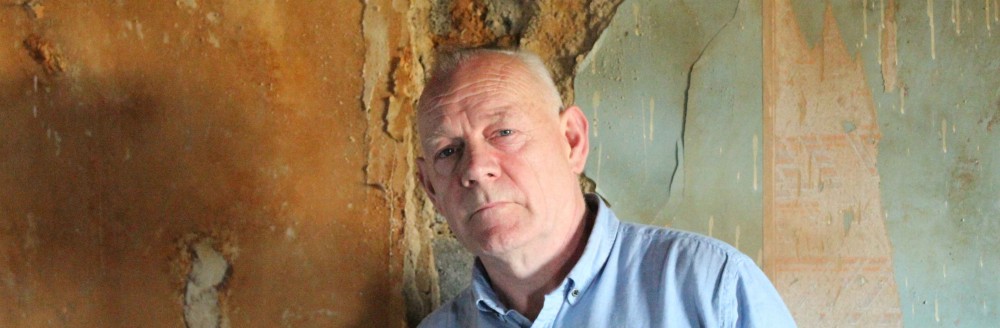
For those of you within driving distance of Dundalk town there will be a very interesting talk given by Fiachra Mac Gabhann this Friday June 10th on Irish Place Names.  It will be well worth attending. No booking needed.


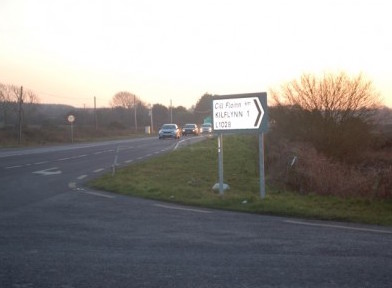
kilflynn

Kilflynn, Co Kerry……


An Archive of Our Past: Placenames and Sense of Place

Speaker: Fiachra Mac Gabhann

Time: 8.00pm

Venue: Wellington Hall, St. Mary’s Road, Dundalk

Date: Friday, June 10th 2016

Organisers: Dundalk Culture Club


Toponymy – the study of Place Names – gives us a fascinating and unique access to our past. It connects us to the landscape and nature and is a well­spring of geographical, historical and mythical information.

Fiachra Mac Gabhann presents a talk that will draw on his extraordinary ten­ volume study of the Place Names of County Mayo, Logainmneacha Mhaigh Eo, to examine some of the intricacies of these themes and piece together some of what has been lost, and offer perspectives on the historical and cultural significance of Irish placenames to our sense of identity.

Admission is Free but donations are welcome. 

This event has been organised by the Dundalk Culture Club.

Conflict + the City – Free talks

Some of you might be interested in this two day conference at Liberty Hall. The event is free but you must register through the email at the bottom of this press release.  It is a public event and open to all.

31st May-June 1st 

List of speakers can be found here: http://conflictandthecity.ie/speakers/


CONFLICT + THE CITY – Public Conference in Liberty Hall Theatre  (FREE)

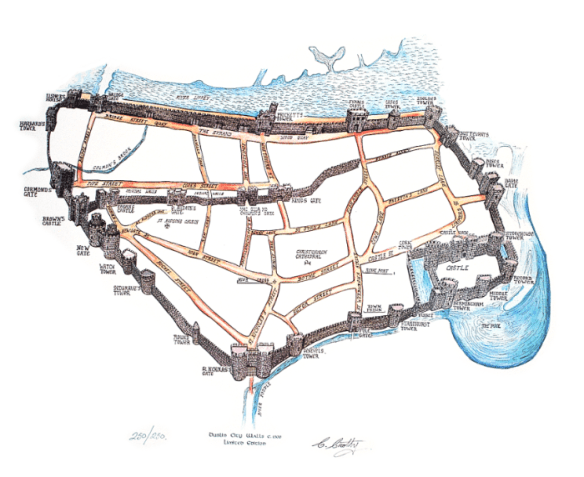
City Wall CHAPTER 5-700x572Dublin City Council’s Heritage Office, in conjunction with UCD Decade of Centenaries, is organising a two-day Public Conference entitled‘Conflict + The City’ in Liberty Hall Theatre. The Conference is aimed at the general public and admission is free.

Over the two days speakers will engage with the audience in discussing the effect of war on the streets and buildings of cities, the rebuilding that then happens and how this affects the way we experience our cities today. Day one will mostly concentrate on Dublin post-rebellion (and post-1922) and then broaden out to look at major cities across Europe with international speakers focusing on Beirut and Berlin. Day two will look at Jerusalem, Belfast, Sarajevo, and the contemporary situation in Calais, for examples.

Speaking about the conference, Charles Duggan, Heritage Officer with Dublin City Council said “This conference is designed for the general public, for anyone who has an interest in Dublin and how the city was rebuilt after the conflicts that took place from 1916 to 1922. But as well as that, we will be placing Dublin in a greater European context and looking at the effect of conflicts on other great European cities. A host of International speakers, together with local experts will deliver talks on an aspect of the city that has yet to be explored.”

Dr. Ellen Rowley of UCD said “Staying in the twentieth century, this two-day public conference will present research into various architectures of war and cities in repair, from Beirut to Blitz-time London; from Cold War bunkers to Belfast’s peace-lines. Today, in Dublin, much of how we move through, spend time in and experience the city comes out of the 1920s reconstruction projects. The scars of conflict and the efforts towards rebuilding resonate through Dublin’s architecture, almost 100 years later.”

ENDS

The conference is free but booking is essential.

For more information see W: www.conflictandthecity.ie

E: heritage@dublincity.ie T: (01) 222 3090


Happy Birthday Pecker Dunne

1st April 1933-19th December 2012

Pecker Dunne broke the mold.  He was one of the great liberators of the Travelling community and from the Travelling community. He was a fluent conversationalist and his wit and intelligence and expression could transform and transcend any company.

He was always a man who would stand up to prejudice and racism not just on behalf of his own community and himself but on behalf of others. He knew hardship and empathized with the hardships of many others outside of his own kind, own clan and own community.

If the word ‘hero’ applies to anything, well then it applies to Pecker Dunne and his epic life journey.  The testament to the man and his artistry, his humanity and his commitment to his community and family are a well-known legend and live on today through his children and his wife Madeline and indeed the very essence of the Pecker himself.

For those that knew him and experienced him, he is part of our living culture.  That essence will never die.  Like the great Irish legends that were written down in Clonmacnoise, the Pecker Dunne engrained his experiences and his artistry and his music into our society, into our everyday.  And we are the richer for it.


Peckers tune,  Tinkers Lullaby, written for his young son, is an anthem about the Travelling community.  It is a deep lament in the great tradition of lamenting and indeed keening.  It is grief stricken but its melody and lyrics are full of hope and love and dignity.  Learn it and sing it.  From the GAA grounds of Limerick to the Rugby grounds of old Landsdowne road, to the race tracks of Galway, the streets of Dublin and Donegal, and the corners of Ballybunion through fields and encampments, roadsides and halting sites and the grand music halls and concerts venues of America – the Pecker Dunne can still be heard if you care to listen.


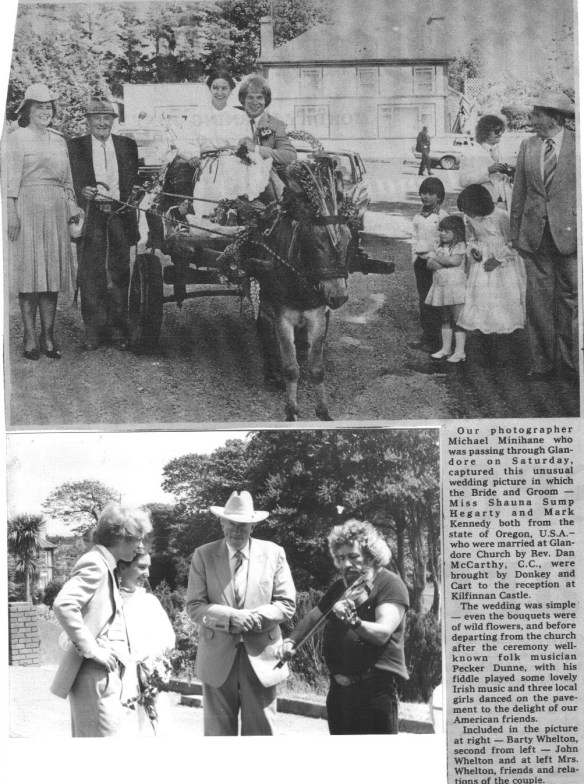
Kennedy and Pecker Dunne 1981 one

Kennedy Wedding, Glandore

The above photos are from the wedding at Glandore, Co Cork (Cuan d’Ór ) in the early 1970tys of a young American couple Miss Shauna Sump Hegarty and Mr Mark Kennedy both from Oregan USA. Pecker Dunne played music at their wedding as he did at many a wedding.


Pecker Dunne casket

The simple coffin of Pecker Dunne. A burial full of humility and serenity.


Tinker’s Lullaby 

Go to sleep my little tinker
Let all your troubles pass you by
For you have no place to camp now
Ah that’s a tinkers lullaby.
Ever since you were a baby
Cradled in your mothers shawl
Society said they did not want you
And now you have no home at all

When your mother died and left you
You had to fend all alone
All in this land of saints and scholars
And still you have not got a home.

Although your clothes are torn and ragged
And your hair is silvery grey
Some day you’ll die and go to heaven
And you will find a camp ground there.

Go to sleep my little tinker
Let all your troubles pass you by
For you have no place to camp now
Ah that’s a tinkers lullaby.


Everybody in Ireland and indeed the world should get to know the Pecker. Listen and learn from his music and become wise from his shared experiences.

Breithlá Shona Dhuit Pecker agus go raibh míle maith agat.


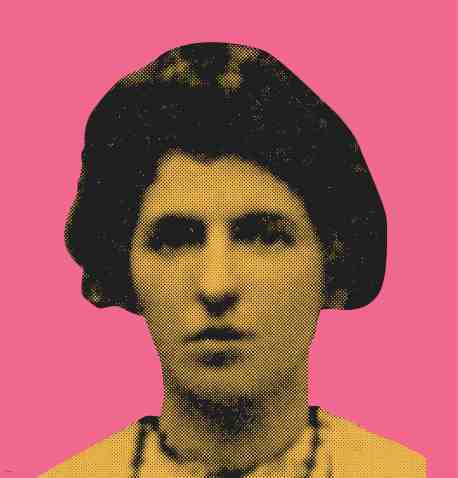
Women of 1916- Áine Ceannt

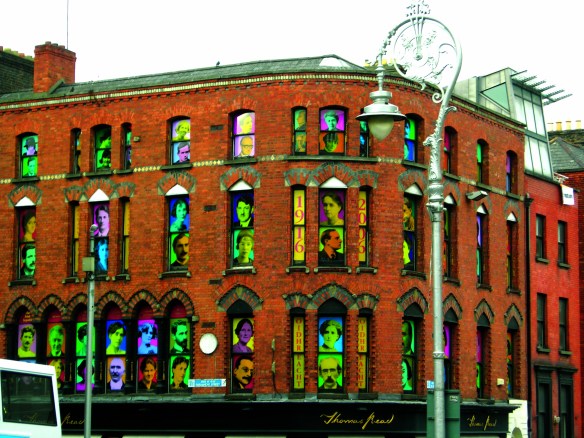
The images on this site are from our installation ‘Something to Live for’ situated over the Ivy on Parliament Street and Dame Street Dublin.  The work was first installed in 2006 and has been reinstated for 2016.

Aine Ceannt

Áine Ceannt (née Brennan) – Something to Live For


Áine Ceannt (née Brennan)  1880-1954

Frances O’Brennan is best known by her married name, Áine Ceannt, as the widow of Eamonn Ceannt, one of the leaders of the 1916 Rising.

Frances was born on 23 September 1880, four months after the death of her father, Frank O’Brennan. Elizabeth Butler, Fanny’s mother got a job as a nurse in a workhouse after her husband’s death.

At the turn of the century Fanny joined the Gaelic League and, like many of the other women who became interested in the Irish language, she adopted an Irish name, Áine.  It was in the Gaelic League that she met Eamonn Ceannt. Their first encounter was on an annual excursion to Galway in 1901.  The couple married on 7th June 1905.  Their son Rónán was born on 18th  June 1906. Eamonn worked in the Dublin Corporation.  By 1916, he was the assistant to the City Treasurer and commanded a substantial salary.  He was a committed nationalist; in 1913, he joined the Irish Volunteers as a Private and rose to the rank of Captain.  He was in charge of the South Dublin Union garrison in 1916.

Just before his execution on 8th May 1916, Eamonn Ceannt wrote a last letter to his wife: ‘My dearest wife Áine. Not wife but widow before these lines reach you….Dearest ‘silly little Fanny’ My poor little sweetheart of – how many – years ago…Ever my comforter, God comfort you now.  What can I say? I die a noble death, for Ireland’s freedom…You will be – you are, the wife of one of the Leaders of the Revolution.  Sweeter still you are my little child, my dearest pet, my sweetheart of the hawthorn hedges and Summer’s ever….’

Like many of the other widows, Áine moved into a public role following the Rising. She had been a member of Cumann na mBan from its inception and her sister Lily, was in the Marrowbone Lane garrison. Áine served as vice-president of Cumann na mBan from 1917-1925.  In 1918 she contested the elections for the Urban District Council of Rathmines and was vice-chairman for a period.  During the years 1920-21, she acted as a District Justice in the republican courts in the Dublin suburbs of Rathmines and Rathgar. During the War of Independance, she sheltered men on the run; one of the many who stayed with her was Robert Barton.  She also acted as an arbitrator for the Labour Department of Dáil Éireann in wage disputes throughout the country.

In 1920, she became the founding member of the Irish White Cross allocating funds for the benefit of orphans of wars in Ireland.  By 1941 the office had closed but Áine archived all the papers and wrote a history of the White Cross from 1920-1947. 

From 1939-1947 she was a member of the Red Cross.  Mine died in February 1954. Her funeral took place in her local parish in Dundrum, County Dublin and she was buried in Deansgrange cemetery.

From the installation ‘Something to Live for’ Parliament St/Dame St Dublin by Farcry Productions Ltd.

http://www.1916onehundred.ie

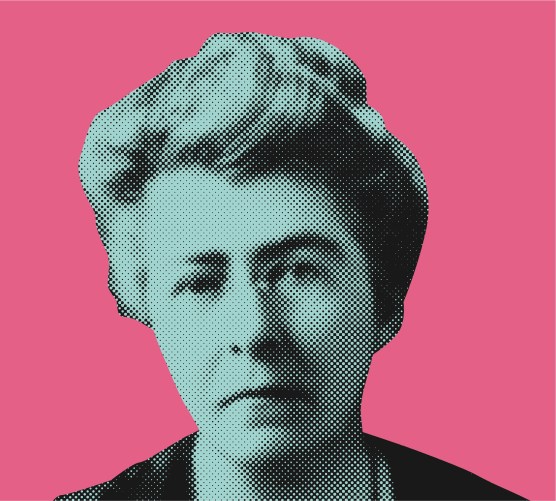
Hanna Sheehy Skeffington 1877-1946

Hanna Sheehy Skeffington

Johanna Sheehy was born in Kanturk County Cork in 1877. Her father was a nationalist MP for South Galway. David Sheehy was imprisoned many times for his part in the Land War. Hanna was educated in Eccles St, Dublin. She later went on to St Mary’s University obtaining her degree from the Royal University of Ireland.

In 1920, she achieved a first class honours MA. She became a teacher in Eccles St and later taught French and German in Rathmines College of Commerce. In 1903 she married Francis Skeffington, a university registrar, Francis was totally committed to equality and, very unusually for the time, took Hanna’s surname.


In 1912, she and her husband founded the Irish Citizen.
During the Rising, Hanna brought food to the different outposts and Frank tried to set up a citizen’s militia to stop looting. He was arrested by the British authorities and shot on the orders of Captain Bowen-Colthurst. Bowen-Colthurst was found ‘guilty but insane’ at his court martial. Hanna refused the compensation and insisted on an inquiry into his death.

At the end of 1916 Hanna travelled to the US and spoke at 250 meetings across the continent. Her tour raised $40,000, which was handed over to Michael Collins. Forbidden by the Government to return to Ireland Hanna smuggled herself in via Liverpool in 1918, but she was soon detained and imprisoned in Holloway Jail along with Kathleen Clarke, Maude Gonne and Countess Markievicz. During the War of Independence, she was active in Sinn Féin. In 1920 she was elected to Dublin Corporation.
1926 Hanna supported Eamon de Valera during the Sinn Féin split and joined Fianna Fáil.

Hanna died on Easter Saturday, 20 April 1946.

She really deserves to be looked up if you have read this far as her life and achievements deserve a website onto themselves.  The images are part of a series of works entitled ‘Something to Live for’ at Parliament Street, Cork Hill, Dame Street Dublin.  1916 One hundred website


frontview1


Mrs Kate O Callaghan 1885-1961

Everyday I will post a short biography and image from the ‘Something to Live for’ window installation at Parliament Street/Cork Hill/Dame Street Dublin.

Today is Kate O Callaghan who had a major influence on the cultural life and politics of Limerick City.


Kate Murphy was born near Macroom, Cork in 1885. She had 14 brothers and sisters, 11 of whom survived to adulthood. She obtained a degree from the Royal University followed by teacher training in Cambridge. She took up her sister Máire’s post as a teacher in Limerick at Mary Immaculate College.
In July 1914 she married Michael O’ Callaghan and passed her job on to another sister, Éilis. She joined the Gaelic League along with her sisters and was a founder member of the Cumann na mBan Limerick branch . Her jusband became Lord Mayor of Limerick in 1920 and was shot dead by masked men in front of her (believed to be Black and Tans), She was left a widow at 35 years of age. She began a campaign to countermand the authroities ‘version’ that he had been killed by and extreme element of the IRA.  Her pamphlet, The Limerick Curfew Murders,  was circulated in Ireland, England and America.
In 1921 Kate was elected to the Dáil. She opposed the Treaty and in 1922 called for increased women’s suffrage.  She lost her seat in 1923 but remained a very active member of the cultural life of the city and was a member of the Limerick Drama Society, Féile Luimnigh, Limerick Art Gallery and the Gaelic League.  When she died in 1961 members of the old IRA carried her coffin draped with the tri-colour.  She was buried at Mount St Lawrence cemetery next to her husband.


Link to The Limerick Curfew Murders http://museum.limerick.ie/index.php/Detail/Object/Show/object_id/11690

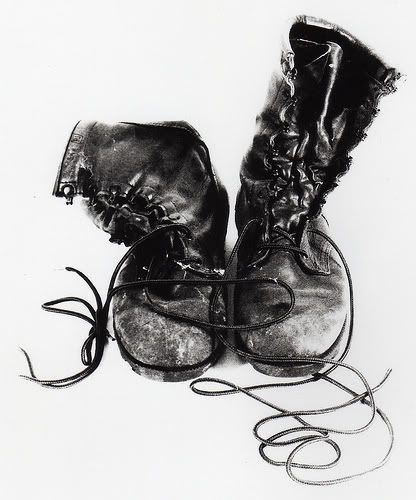
Johnny Murphy Forever

boots

I am obliged to you. Ah, pardon, it’s I am obliged to you. Its we who are obliged to each other. 


Johnny Murphy was an extraordinary talented Dublin artist. He once told me he discovered his talent for performing in the Don Bosco in Crumlin, but I remember seeing Johnny in the many many great productions that the late Deirdre O Connell did at the Focus Theatre. They were the great European classics, Ibsen, Strindberg, Chekhov. Huge talent on a tiny stage, in a tiny place, bursting at the seams. The passion, the commitment, the drive, the humanity that emanated from Johnny Murphy’s performance was something that I carry to this day. Those days, that stage, that place were shared with other greats, Gabriel Byrne, Ena May, Tom Hickey. These people created a whole new energy which was later harnessed into the Project Arts Centre under the baton of the Sheridan brothers, Jim and Peter who assembled a dynamic bunch of individuals that, in my view, changed the course of Irish acting, Irish performance, Irish playwriting, Irish stage writing and dramatic energy.

Johnny Murphy was a vital part, an essential ingredient, a navigator in all of that.

From Yeats’ work to Beckett’s work to Jim and Peter’s own works, the whole collaboration of the Project Arts Centre all boiled down to one ingredient – the performance of the artist and actors. Johnny Murphy was a star attraction. Not just on that stage, but in people’s lives. He was a very generous, no bullshit person who could cut to the chase. I had some fantastic times with Johnny during my time at the Project and in the many plays and tours that we all did as a company.

I deeply respected and appreciated his guidance, his consideration, his understanding and his generous love and what a funny guy. He was blessed with a marvelous wit and a comic genius. He could hold a stage and an audience anywhere. He could mesmerize with a look.

Nobody, that I know of, has ever forgotten a Johnny Murphy performance. Throughout the last number of years of his life he was as active as you possibly could be, particularly after giving what I believe was one of the most definitive performances in the history of Waiting for Godot, when he played the tragic, fabulous Estragon alongside Barry Mc Govern’s Vladimir at the Gate Theatre.  It was way back in the Project Arts Centre’s production of Waiting for Godot that Johnny first unleashed that performance and interpretation of Estragon to packed houses.

Drimnagh and Dublin are proud of Johnny Murphy.  An artist, a father, a brother and a son. Many of us who also loved Johnny, and I mean loved Johnny Murphy, will grieve and miss him. But we will always be reminded of Johnny as we pass his many haunts, his many theatres, and when his many friends gather in different groups, both now and into the future, to talk and remember.   It was Samuel Beckett who coined the phrase ‘we are born astride the grave, the light gleams for an instant, and then it is night once more’.  John Murphy’s light gleamed brightly in our hearts and in the limelight of the stage forever.  We are obliged to you Mr Murphy.

My deep condolences to his daughter, his family, his many friends and his many audiences.

Johnny, your cue. You’re on.”


Busking bylaws. The facts.

                          Street performance and Dublin City Council bylaws

There is a group of individuals who claim they represent all buskers who have been putting out  misinformation, not just about Dublin City Council, but about me in an unjust and inaccurate attempt to demonise and label me as anti-busking and anti-culture. This is not true.

Firstly, nobody, is attempting or has suggested banning busking or street performance.  At present, there is a document in the public domain seeking observations and suggestions with regards how we manage the public domain in relation to street performance. This is part of the democratic process of enshrining the rights of street performers while on the other hand maintaining a balance in the public domain which is also the workplace and home for thousands of people.

Over the years many residents and workers have complained to Dublin City Council and public representatives about the unbearable noise levels at certain locations in the city – mainly Grafton Street, Temple Bar, Henry Street and the GPO.

Having tried a voluntary code of conduct with regards performers’ noise levels, the City Council  decided it was appropriate to create a series of bylaws to help to manage the public domain more effectively.  These bylaws were enacted into law a year ago with a review period that would fix any blaring omissions or further complaints. 

The concerns at present mainly relate to amplification and noise levels and a general wish by many residents and workers to ban amplification which, as well as being a nuisance, drowns out acoustic buskers.  I am not against busking, but, like the residents and workers in the city centre, I  support this ban on amplification. 

This whole process has been democratic, open and transparent where everyone gets heard – unlike on Grafton Street or Temple Bar sometimes when you can only hear the noise that is so loud your head hurts. Anybody interested can read a copy of the new bylaws under consideration before they are voted upon and the voting process itself can be viewed by all when they are discussed at length in Dublin City Council at the Arts Strategic Policy Committee which is webcast live and available online to view after the meeting also.

Rest assured that Street performance and busking will always be a feature on Dublin and Irish streets and Irish culture is the richer for it.

I hope this clarifies some of the issues, even if it doesn’t stop the devious few who want to undermine me and who last year smashed the window of my former studio on Ormond Quay and graffitied disgusting comments all over the building.

Long live busking. Long live street performance. Long live a safe and healthy work place for all.

Unique Dublin Artefact – John ffrench/Mirolo Mosaic


Mosaic_Mirolo

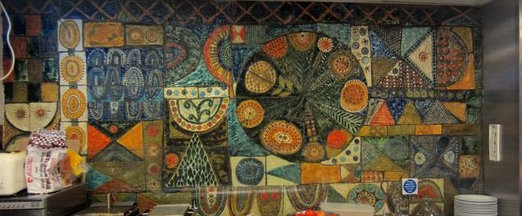
Mosaic in Boyers Restaurant, Dublin by John ffrench Irish Artist installed by Joe and David Mirolo – (The work is signed 1967)

Boyers of Earl Street is closing its doors for good.  Generations passed through these doors and the place is a wash with memory.  It is important to keep that connection to that memory, to that heritage, to that witness.
In the restaurant of Boyers is a mosaic artwork that many Dubliners over the generations enjoyed.  Too much of this unique work has been previously lost to skips and landfill.  Too many of our unique buildings, streets, have been simply bulldozed and replaced by ugly shopping centres or even uglier office blocks.  A thing of beauty is a joy forever.  This work was installed by Joe and David Mirolo an Italian-Irish family who made a cultural contribution through their trade to this city and indeed to this country.  This is multi-culturalism.  This artwork is the evidence and we must save this artefact, conserve and protect it for the joy and education of future generations. We cannot lose it or let it be taken away.
The Little Museum of Dublin would be an ideal place for this work to be represented and presented back to the Dublin people or any other similar place like it.  Indeed, I would go so far as to say that the North side of Dublin needs its own Little Museum of Dublin. We didn’t save Wood Quay in the past or the Quays.  Much of Dublin has been destroyed despite our cries – surely we can save this fine piece of Italian-Irish heritage? #loveculture
About the Mirolo family:
Guiseppe Mirolo came to Dublin in the 1930s, before the First World War he was studying medicine but that was all to change. He served his apprenticeship with artisans from his home region of Friuli in Northern Italy, he was also a ‘profigi’ or in modern terms a refugee. He worked hard to create a good life for his family and loved Dublin.
Some of his work survives in Dublin and in Christ the King Cathedral and the mosaic’s in Mullingar. The Harp on the steps of Walton’s Music Shop on North Frederick Street is his. The floor of the iconic Waldorf Barbershop is his floor.  The Mirolo family have been involved in Terrazzo & Mosaic for four generations now.
About the artist John ffrench:

John ffrench was born in Dublin to Irish and Italian parents. Travel and foreign inspiration has always been a factor in his work. His early art education was in design, drawing and calligraphy in the National College of Art in Dublin. In 1951, ffrench went to the Institute Statale d´Arte in Florence to study under professor Bruno Pauli. He stayed on in Italy until 1955 to work with like-minded ceramicists on one-off pieces and to soak up the innovations of Italian Modernism. The Mediterranean influence, so apparent in his work from then on, set him apart on his return to Ireland. At this time, Ireland had virtually no craft pottery tradition and mass produced and imported work was standard. Even in the 1950´s, the new craft schools based on the Bernard Leach school favoured the Anglo-Oriental style of dun-coloured pots, the “little brown pots” as they were known.

When ffrench returned to Ireland in 1956 he set up the ‘Ring Studio´ in Kilkenny with Peter Brennan. He began to create pots unlike any seen previously in the country; ffrench preferred to hand build rather than throw his pots and they were very sculptural and experimental in form. The cubist paintings of Picasso and Braque inspired both the ceramics and paintings he made at this time and much of his work was large and irregularly shaped (to the point that his work was described as “too obstinately asymmetrical” by a Dublin newspaper).

In 1962, ffrench returned to Ireland and founded the Arklow Studio Pottery. The Scandinavian Report into the status and quality of craft in Ireland had been scathing, a government initiative to improve standards by involving experts in the various fields was set up. Ffrench was closely involved in this capacity with Kilkenny Studios, which was producing designers for various industries. Influences from his time spent in India were seen in the imagery, colour, form and pattern work of his time. The studio produced tableware, pots, jewellery, wall panels in colourfully glazed, stamped and gilded finishes. In 1969, he moved to America and opened the Dolphin Studio in Massachusetts. With his wife he added batik works and silk-screen prints to his range. He made cheerfully coloured decorative temples and mythical buildings made from individual tiles and arranged like children´s building blocks. In 2007, John ffrench was honoured with a lifetime achievement show from the Arts Council of Ireland.

Save the enjoyment of busking/street performance

BuskingThe art of busking as it is known, is a centuries long tradition.  It sits alongside the street trading traditions that we have in our cities.  Where it differs now is that street performance/busking, as it is now known, is totally unregulated and therefore unmanageable and ungovernable.  More and more street performers are engaged on our streets which is a good thing and now a world renowned practice.  So much so, that the likes of the Edinburgh festival and the Sydney Fringe festival thrive as a result of the outstanding standard of street performance and busking.  Those standards and achievements were made because of the making of strong regulation and bylaws that Edinburgh and indeed Sydney were able to rely on to ensure public enjoyment of the performances and indeed enjoyment of the public domain.  They go hand in hand so to speak, like Estragon and Vladimir. Not so in Dublin at present.

The villain here is the amplifier.  And amplification that totally dominates voice and acoustic instruments and bombards the publics sensibility as they try and go about their business in some of Dublin’s most iconic and busiest streets.  The amplifier in busking and street performance  is like a virus.  It has the same effect as foot and mouth.  It kills creativity and wards off other artistic individuals who wish to use our public streets as a cultural platform.

The current campaign to retain amplification is largely being orchestrated by one outfit.  A managed band that uses excessive amplification and in my opinion (and those of the many citizens who have written to me on this issue) dominates the atmosphere in certain streets with amplified noise.  It is easy for many of their supporters to walk up these streets and out of these streets.  However, if you live and work in these areas you don’t really have that choice at all. The pro-amplification supporters don’t have to put up with the constant noise day in day out, hour in hour out.  It is rather selfish and indeed arrogant for certain street performers/buskers to be insisting that they have more rights than any one else in the public domain.  This is not in keeping with artists and arts practice.  And is certainly not in keeping with cultural democracy and cultural participation.

The Glen Hansard’s of this world and the Hot House Flowers, Paddy Casey etc all used acoustic instruments to great effect back in the day.  And went on to be the successful world artists that they are today.  Nobody is trying to stop busking or street performance but it can only thrive through proper legislation and management of the public domain for the public good. Indeed, many of our finest traditional street performers who use non amplified instruments cannot compete and are moving elsewhere to quieter places.  It is many of those buskers that I have personally spoken to who believe that the amplifier is the death knell of the tradition of busking.

The set of bylaws that are at present before the City Council regarding street performance are extremely generous to buskers and performers but they are not so generous to residents, workers and indeed citizens who are sick and tired of the noise and obstruction that is an almost daily occurrence on certain Dublin streets.

We are inundated now as Councillors with hundreds of emails of concerned individuals who are confused and misunderstand what’s actually happening at City Council regarding the new bylaws this evening.  Again most of these emails are visitors to Dublin or people who do not live within constant earshot of the amplified noise and repetitive sound of the same songs being played over and over again like bad karaoke.

The stage is to be shared after all, it is the public domain.  You share the stage with your fellow artists, with your audience and your public.  No fellow artist or act should continuously upstage or dominate the atmosphere by persistent indifference to others.

I feel it is time for certain buskers and indeed Dublin City Council to turn off the volume and listen. Tonight I will be proposing a temporary ban on all amplification for buskers and street performers for 12 months.  In 12 months time the whole street performance bylaws will be reviewed and amendments made if necessary.  Equally if there is a strong case presented or made for the use of amplification in certain areas where it won’t be a noise nuisance to residents and others, so be it.

For too long certain buskers and street performers have had it all their way regarding issues of noise.  It is not today nor yesterday that citizens became annoyed at the lack of consideration due to amplification in busking and street performance.  There was an attempt some time back at a voluntary code for street performers.  It didn’t work. These  new bylaws are coming as a result of what was learned in trying to implement the voluntary code.

The best performance now that certain buskers and street performers could do, is to support this temporary suspension/ban. That would certainly enshrine them in the eyes of all the public, of all the workers and all the residents in the city.

Graciousness, humility and serenity as well as dignity and a sense of purpose to society is the hallmark of any would be artist in any art form. And excellence is the marker.  But none of them compare to the respect that you afford your audience or your would be audience of society as a whole.  This city, Dublin, is a landscape of conflict.  An urban space full of hustle and bustle, trespass and forgiveness where we all rub up against each other, sometimes in the wrong way. But we usually beg pardon and as Samuel Beckett would say ‘we are obliged to each other’ and we move along in good fashion.

A city can only thrive as a result of tolerance.  It can never progress with intolerance or anti social behavior. Certain buskers and street performers need to become more aware of the need of others for quietness, for balance so that everybody can enjoy what is theirs. The public domain.  The present bylaws are primarily driven to ensure an equal playing pitch for all. If we continue with the present regime it can only erode public admiration for the art of busking and street performance.

To ensure that this does not happen, I’m calling on all my colleagues to support the public’s call and the many acoustic playing street performers and give us back our friendly noise free streets from loud noisy amplified busking/street performance.  Enough is enough.